Reuse, with constraints.
Search within canonical libraries. Use an existing component and a verified variant. Apply the relevant product pattern.
Workhuman / Recognition / AI-assisted design
I built a context system that helps an AI assistant work with the product we actually have: the right components, documented patterns and decisions that survive the next session.
Explore the context gate ↓
Context decision map
The available context determines the next step. Both outcomes are shown below.
A plausible layout is not enough. It must belong to the product.
Search within canonical libraries. Use an existing component and a verified variant. Apply the relevant product pattern.
The assistant explains what it does not know and asks for a reference or confirmation. A hypothesis does not silently become a design rule.
Architecture illustration based on the skill and decision records. The diagram explains the documented rules; it does not connect to company systems.
The starting point
Early AI-assisted work exposed three different problems. A better prompt alone could not resolve all three.
An unrestricted component search could surface archived libraries ahead of the current system.
Constrain where the agent looks.The assistant could recreate a component or choose a variant without checking that it existed.
Verify before instantiating.Correct-looking components could still be assembled into a flow that did not match the product.
Make product patterns explicit.I built on existing foundations owned by another team. The new work was the Recognition-specific context: how components are used, which decisions apply and where the assistant must ask rather than infer.
Learning through use
Applying the system to a real feature exposed where reusable rules and application-specific behaviour were mixed together.
Read the relevant context before design work begins. Constrain component search and stop when a required pattern is missing.
Documented implementationI tested the approach on Media within Recognition. A real feature gave the context structure something concrete to support.
Applied in my practiceI reorganised the context after the pilot, separating reusable feature knowledge from how it behaves in a particular application.
Reorganisation completedI am continuing to improve context selection, durable decisions and the structure needed to support more design work.
Ongoing refinementThe September planning document describes the intended reorganisation. I subsequently confirmed that I completed the reorganisation after testing on Media. That updates the planning snapshot; it does not mean every proposed phase or distribution mechanism has been completed.
Plugin distribution, shared review processes and index-size targets remain separate roadmap items in the available evidence. No measured time saving or wider team adoption is claimed here.
Architecture
The context needs to explain both what a capability does and where it lives. These responsibilities should be independently understandable.
Consumed as source material; not recreated or claimed as my invention.
Media, captions and their behaviours across states. Knowledge that can apply in more than one product surface.
The container, layout and interaction constraints of the surrounding flow. A modal and a full screen can share a capability without sharing a layout.
Verified component identity and properties, paired with curated guidance explaining when and why to use it.
Why a choice was made, its scope, its status and what remains unresolved.
Conceptual view of the context responsibilities. Updating the written context does not automatically update existing Figma frames.
An index helps the assistant choose what to read. The useful instruction includes a condition: open the component guidance before choosing a variant, or consult the application context before placing a feature.
The initial index had accumulated long descriptions and session history. The evolution plan moves detail into the relevant documents and keeps the routing layer focused. The goal is selective reading, not an invisible indexing engine.
Durable design judgment
The system distinguishes extracted facts, confirmed decisions and hypotheses. The assistant should know which kind of statement it is using.
A property or variant read from the source component. Keep its origin clear; do not replace it with an assumption.
A design rule validated by the designer and recorded with its scope. This can inform subsequent work.
An interpretation that still needs confirmation. If it is the only basis for a design choice, ask before proceeding.
A concrete decision
An existing modal contained both confirmation and approval/rejection behaviours. I chose to expose the differences through properties rather than remove them or split the component into separate families.
The record preserves why the choice was made, how the mobile actions were reorganised and which defaults still required a decision.
The value is not just remembering the final answer. It is preserving the trade-off and the uncertainty, so the next session does not start from the same assumptions.
Evidence and next steps
The gate, context documents and dated decision records provide the foundation for this story. My Media pilot and subsequent reorganisation describe the next stage of the work.
The August verification record describes scoped component-search results and a blind test in which the assistant requested a reference instead of inventing a pattern. These are historical checks documented at the time, not tests repeated for this page.
The source package also contains curated component guidance, product patterns and dated decision records. I designed the context system with AI assistance for writing and execution.
How to keep routing instructions concise, preserve the distinction between reusable and application-specific knowledge, and make reviewable decisions easier to carry into subsequent tasks.
The broader roadmap includes distribution and shared review. Those require their own implementation and validation; the documents do not establish company-wide adoption or production outcomes.
Sources: design-context specification and gate verification record, August 2026; modal decision record, August 2026; context evolution plan, September 2026; my subsequent account of the Media pilot and reorganisation. Diagrams are portfolio illustrations, not company interface screenshots.
From the source
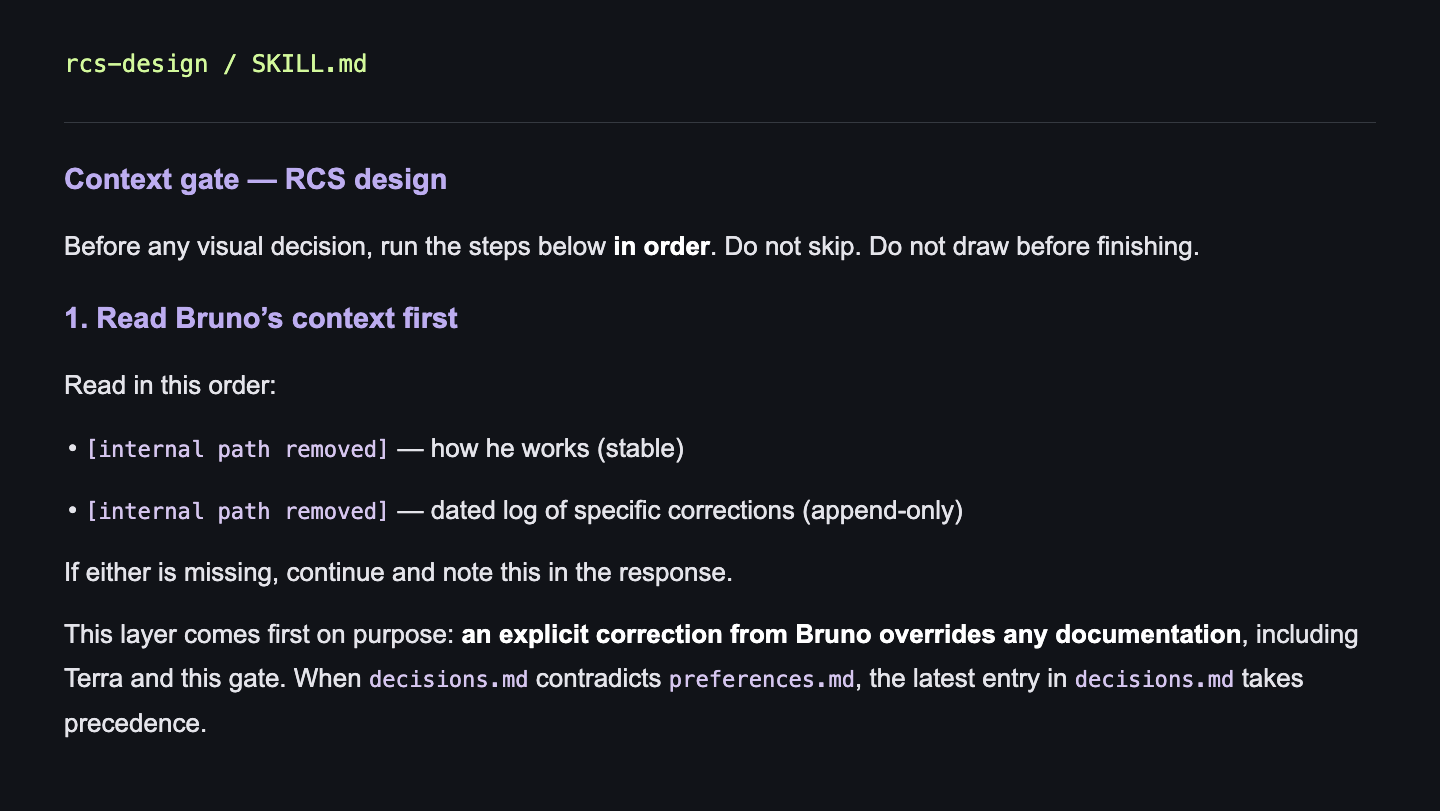
Before any visual decision, run the steps below in order. Do not skip. Do not draw before finishing.
Read in this order:
• [internal path removed] — how he works (stable)
• [internal path removed] — dated log of specific corrections (append-only)
If either is missing, continue and note this in the response.
This layer comes first on purpose: an explicit correction from Bruno overrides any documentation, including Terra and this gate. When decisions.md contradicts preferences.md, the latest entry in decisions.md takes precedence.