01 / Source excerptEN
“Third, I'd list them everywhere — Etsy, Facebook Marketplace, Instagram.”
Page localisation / Personal workflow
I connected specialised AI skills into a workflow for adapting pages to another language, with clear inputs, handoffs and decisions that stay with me.
See an actual adaptationFrom the saved project files · PawArt / September 2026
“Third, I'd list them everywhere — Etsy, Facebook Marketplace, Instagram.”
“Troisième étape : je les mettrais en vente partout. Etsy, Leboncoin, Instagram.”I chose Leboncoin for the French adaptation. The saved edit note carries that decision into production: replace the Facebook Marketplace footage so the visuals match the script.
The language skill asks for cultural adaptation and a short note explaining the changes. The saved bilingual script records this specific substitution and its editing consequence.
“The cultural adaptations made and why”Sources: copy-fr / Delivery and the bilingual PawArt script, Ad 005, beat 8. Bruno confirmed the substitution was his decision. These saved artifacts show the adaptation and editing instruction, not a live agent run or a published video.
The opportunity
An idea could be ready long before the page was.
Inspect the reference. Extract its content. Adapt the copy. Rebuild the page. Check it on mobile. Prepare tracking and delivery. I was repeating that production work whenever I wanted to test another language.
My contribution was to create and adapt reusable skills, connect their stages and refine the workflow through everyday use.
My experience using it
“Work that used to take me days now takes minutes to produce.”
That gives me more room to test ideas in other languages.
Bruno Silva’s personal account of production time, not a controlled benchmark. Producing a page is separate from validating its results.
The system
Each stage has a job, an artifact and a decision boundary. Open a stage to inspect what moves through it.
raw/screenshots/
raw/images/
page-content.jsonThe inspection stage captures the actual page with Playwright: mobile screenshots, text, images, layout and styling. The extracted structure becomes reusable context.
copy-fr
copy-latam
copy-enSpecialised language skills guide tone, phrasing and cultural adaptation. The task is to preserve meaning in the target market, rather than substitute words.
page/index.html
page/assets/The build stage turns the adapted content and layout reference into HTML and CSS. This separates implementation from the writing task and produces a real interface to check.
screenshots + reportsThe workflow calls for browser inspection and Lighthouse. The broader offer workflow also documents removal of inherited tracking and replacement of proof before publication.
page_viewsection_viewcta_clickEvent names, not recorded activity.
The page workflow includes events, attribution and Clarity. Instrumentation makes a later experiment observable; its presence does not prove that the page performs better.
summary + files + open decisionsSales Page Machine includes a deployment stage. Offer Clone Machine explicitly stops before deployment and produces a report. Those are different operating boundaries.
Inside the skills
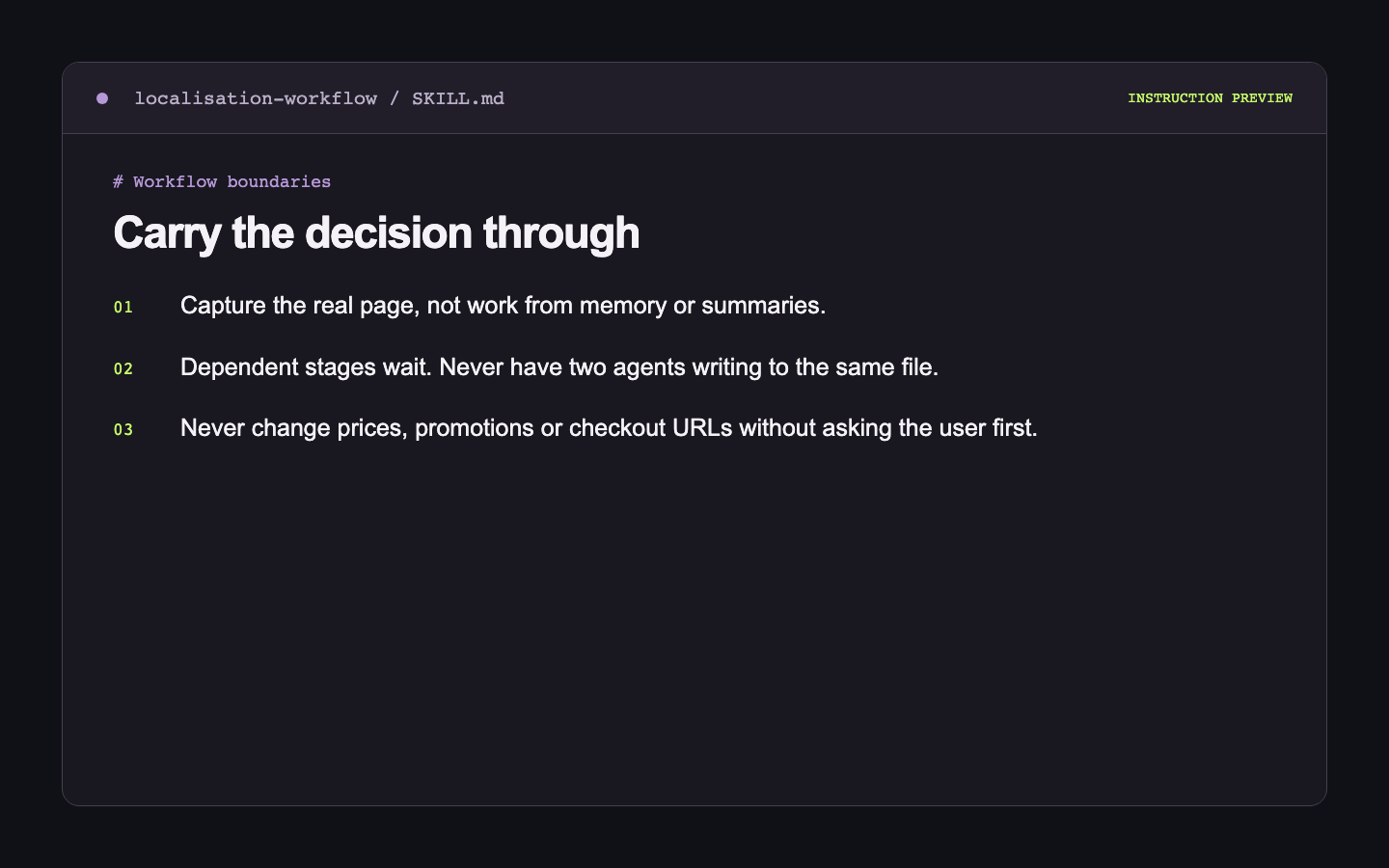
The useful parts are specific: what must be captured, what can run together and what must wait for a decision.
Sales Page Machine / Critical rules
“you must capture the real page, not work from memory or summaries”
The next stage works from an artifact it can inspect, instead of an agent’s recollection.
Offer Clone Machine / Structural rule
“Dependent stages wait. Never have two agents writing to the same file.”Dependent stages wait. Separate file ownership prevents agents from overwriting each other’s work.
Sales Page Machine / Critical rules
“NEVER change prices, promos, or checkout URLs without asking user first.”
Automation handles production tasks; commercial decisions have an explicit human boundary.
Excerpts from my local workflow instructions. The diagrams explain those instructions; they do not execute them.
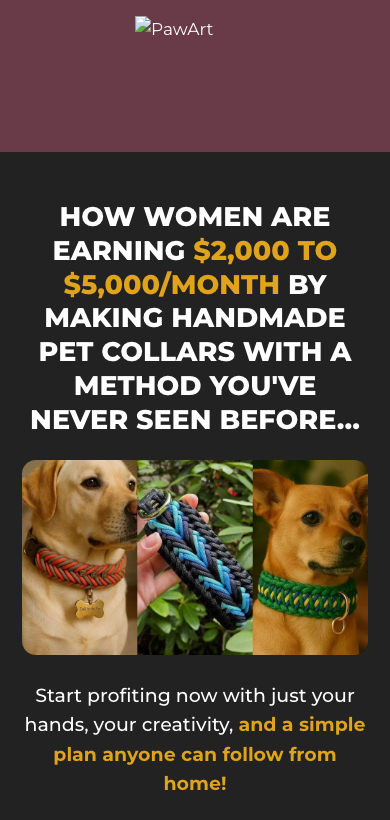
Two local page captures from the PawArt project. The English implementation follows a commercial reference; the French version shows the adaptation. These images demonstrate the artifact, not conversion performance.

Documented application / PawArt
The PawArt project notes record a reference captured in English, an adaptation for a French market and delivery with tracking.
Mobile screenshots by section, extracted text and downloaded reference assets.
Source materialFrench copy, page implementation and market-specific product material.
Working artifactDeployment records, analytics instrumentation and a later behaviour review.
Follow-up materialArtifact categories summarised from project records. This is not a replay of an agent run or a claim of improved conversion.
This application started from an existing commercial reference. My work here is the adaptation and delivery process: giving agents useful context, connecting their outputs and keeping review in the loop.
What this makes possible
The reusable part is more than a prompt. It is a way to define the task, preserve context and make the next step inspectable.
This story synthesises my Sales Page Machine, language skills and Offer Clone Machine instructions. PawArt project notes document an application of the practice.
The production-time observation is my personal account, not a benchmark. No measured speed-up, conversion lift or fully autonomous operation is claimed. Diagrams and artifact illustrations are conceptual.
Inside the workflow