
← All builds

Ad Diagnose · Personal AI-assisted workflow

A recommendation
needs evidence.
An action needs a person.

Campaign analysis can produce a convincing explanation before there is enough data to support one. I use a diagnostic skill that asks for evidence, exposes uncertainty and keeps the decision with me.

Workflow designDecision supportHuman review
Design judgement · Inspect the evidence before choosing a direction.
Design judgement · Inspect the evidence before choosing a direction. Conceptual illustration created with AI.

The boundary is
part of the design.

The skill can inspect data and recommend a next step. It is explicitly instructed not to pause campaigns, change budgets or make changes in Meta. This page visualises those instructions; it is not a live diagnostic tool or a record of campaign results.

Explore the decision path

Enough evidence to continue?

Workflow illustration.
Switch the condition; open a step to inspect it.

01

Input

Start with campaign data.

Metrics, sample context, geography and demographic breakdowns.

anuncios[].metricasgeografia.alertademografiatotais

Wait / Do not conclude

“It is too early”
is a useful answer.

The instruction for confianca: "baixa" is to say that the evidence is insufficient and stop. The workflow can be revisited when more data is available.

No recommendation to scale, pause or change a campaign follows this branch.
03Inspect the journey

Read the funnel in sequence, then inspect delivery context. A weak stage helps form a hypothesis; it does not establish a cause.

Impression → attention → click → landing page → checkout → purchase

gargaloconfiancageografia.alerta

04Make a recommendation

Bring together the verdict, supporting numbers, relevant alerts and a short list of next actions. Separate observations from the proposed explanation.

The skill defines candidate actions such as waiting, varying or scaling. This illustration does not recommend any of them for an actual campaign.

Agent recommendation ends hereHuman decision begins

05I decide what happens next.

I review the evidence and decide whether to act. The agent does not have permission, through this skill, to pause ads, change budgets or modify campaigns.

“For now: recommend; Bruno executes.”

Autonomy instruction from the skill.

06Record the learning

The workflow asks for a postmortem when the outcome is judged conclusive and confidence is high. It records the numbers, sample, suspected bottleneck and lesson for a future investigation.

Evidence & sampleInterpretationReusable lesson

Recording a conclusion does not make it causal proof. The instruction is to read previous lessons before the next diagnosis; this page does not claim that a validated history of accuracy exists.

Prior lessons inform the next investigation.

From the actual instructions

Small rules.
Meaningful constraints.

Excerpts from my local Ad Diagnose skill, with their interaction-design implications.

01 / Evidence

“Never draw a conclusion without the numbers.”

The explanation needs a supporting observation. Fluency alone is not enough.

02 / Uncertainty

“say it is too early and stop.”

The workflow has a stopping condition. Asking for more evidence is an explicit outcome.

03 / Agency

“Do not pause, scale or make changes in Meta.”

Recommendation and execution have different owners. The boundary is stated before an action is proposed.

What this demonstrates

Designing the handoff,
not just the answer.

The product-design problem is how to turn an analysis into something a person can inspect and decide on: clear inputs, a visible stop condition, bounded autonomy and a place to retain learning.

Instructions are evidence of a workflow.

This page is based on the Ad Diagnose skill document. The field names and short excerpts come from that source. The visual flow is a portfolio illustration of its structure, not a screenshot of a shipped application.

The source includes campaign-specific thresholds and rules of thumb. They are heuristics to investigate, not general statistical guarantees. A weak funnel stage can have multiple explanations, and an action such as scaling has no guaranteed outcome.

No live account is connected. No campaign data is displayed, and changing the diagram has no external effect.

Explore another part of the practice.

Back to Build

Inside the workflow

Instructions you can inspect.

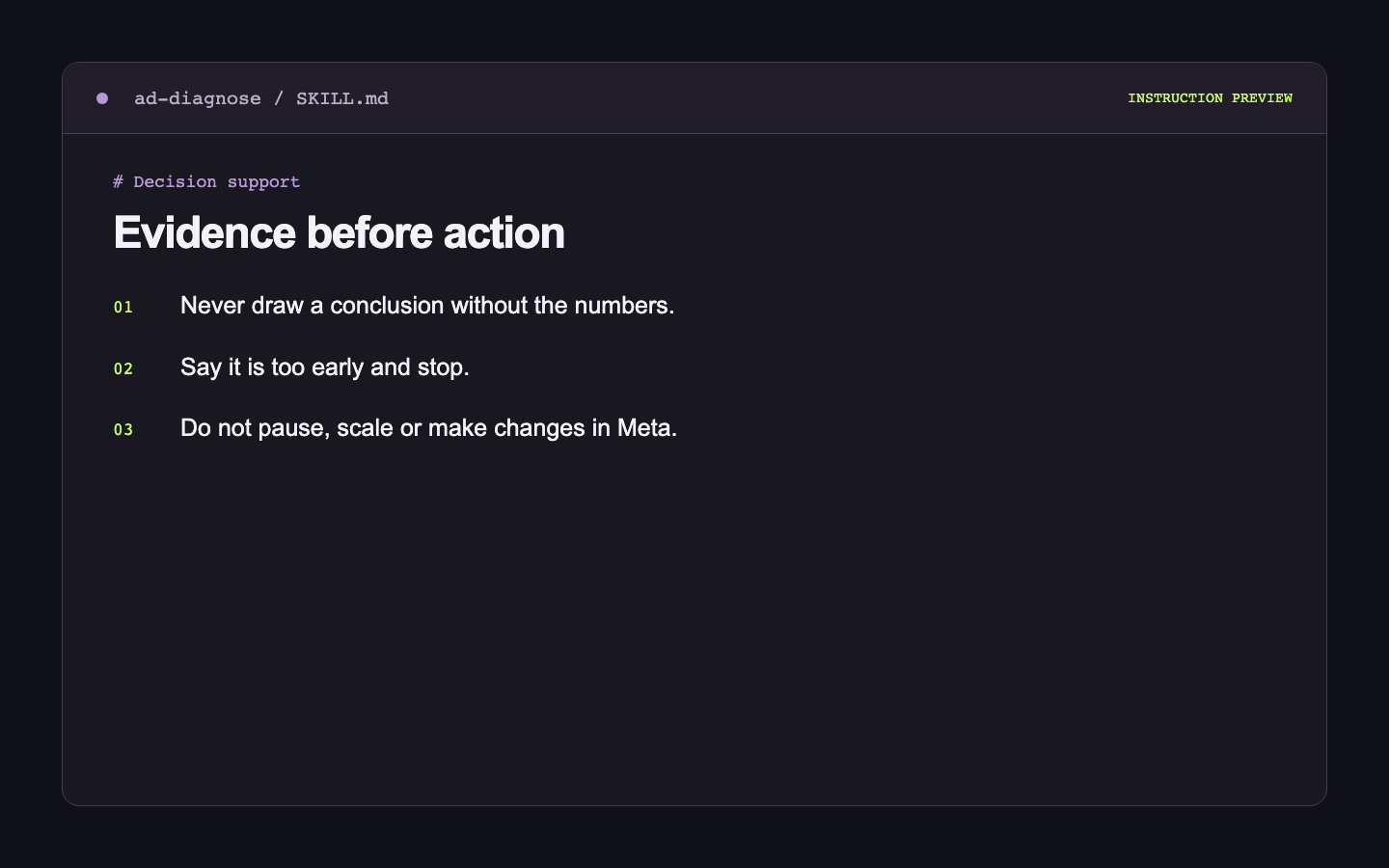
English instruction preview: Evidence before action. Key rules follow below.
  1. Never draw a conclusion without the numbers.
  2. Say it is too early and stop.
  3. Do not pause, scale or make changes in Meta.